Choosing the right air conditioning system is an important decision for homeowners in South Florida. With high temperatures, year-round humidity, and long cooling seasons, having a reliable air conditioner is essential for maintaining a comfortable indoor environment. However, not every home needs the same type of cooling system.
Two popular options are central air conditioning and ductless mini-split systems. Both can provide effective cooling, but they work differently and offer different advantages depending on your home’s layout, existing ductwork, energy requirements, and budget.
If you are planning a new AC installation, replacing an older system, or looking for a better way to cool specific rooms, understanding the differences between these two options can help you make a more informed decision.
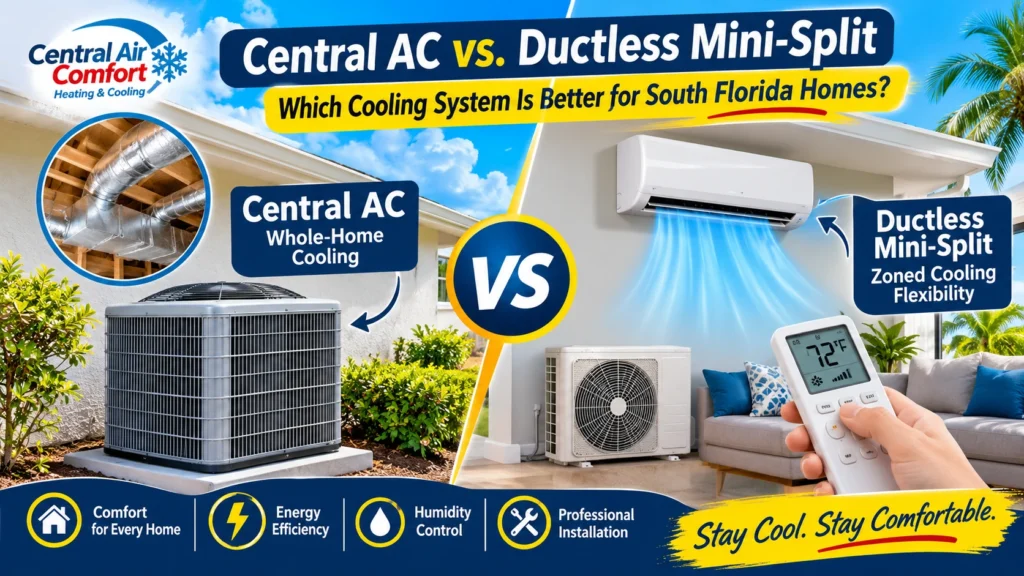
Central air conditioning is commonly used in homes with existing ductwork because it distributes cooled air throughout the property. Ductless mini-splits offer more flexibility by cooling individual rooms or designated zones without requiring traditional air ducts.
In this guide, we will compare central AC vs. ductless mini-split systems, explain their installation requirements, discuss energy efficiency and humidity control, and explore which option may work better for different types of South Florida homes.
Understanding Central Air Conditioning Systems
A central air conditioning system is designed to cool an entire home through a network of connected air ducts. It uses an indoor air handler, an outdoor condenser unit, and a thermostat to maintain the desired indoor temperature.
When the system operates, warm indoor air moves through return ducts and passes over a cold evaporator coil. The refrigerant inside the coil absorbs heat from the air, allowing the system to send cooler air back into the home through supply vents.
This process continues until the thermostat detects that the desired temperature has been reached.
How Does a Central AC System Work?
A central AC system uses several components to provide consistent cooling throughout a property.
The main components include:
- Outdoor condenser unit: Releases heat collected from inside the home into the outdoor air.
- Compressor: Circulates refrigerant through the cooling system and helps maintain the pressure needed for heat transfer.
- Evaporator coil: Absorbs heat from the indoor air as it passes through the air handler.
- Air handler: Contains the blower and helps circulate conditioned air through the ductwork.
- Air ducts: Distribute cooled air to different rooms and return indoor air to the system.
- Thermostat: Monitors indoor temperature and signals the system when cooling is needed.
All these components work together to maintain indoor comfort.
Main Advantages of Central Air Conditioning
Central air conditioning offers several benefits for homeowners who want to cool their entire property.
Whole-home cooling: A properly designed central AC system can distribute cooled air throughout multiple rooms, making it suitable for houses with several bedrooms and common living areas.
Convenient temperature control: Most traditional central systems use a central thermostat, allowing homeowners to manage the overall indoor temperature from one location.
Discreet appearance: Because the main equipment is located outside or in a designated mechanical space, and the air travels through concealed ducts, only supply and return vents are typically visible inside rooms.
Suitable for existing ductwork: Homes that already have properly designed and maintained duct systems can often replace an older central air conditioner without installing an entirely new air distribution network.
Whole-home integration: Central AC can work alongside compatible filtration equipment, thermostats, and other HVAC accessories.
When Is Central AC a Good Choice?
Central air conditioning may be a practical option if your home already has suitable ductwork and you want to cool multiple rooms using one integrated system.
It is particularly worth considering for:
- Larger residential properties.
- Homes with existing HVAC ductwork.
- Properties replacing an older central air conditioner.
- Homeowners who prefer concealed air distribution.
- Houses that need consistent cooling across several living areas.
Before choosing a new unit, an HVAC professional should inspect the existing ductwork and calculate the property’s cooling requirements.
Understanding Ductless Mini-Split Air Conditioning Systems
A ductless mini-split is an air conditioning system that provides cooling without using traditional ductwork. Instead of distributing conditioned air through ducts, it uses one or more indoor air-handling units connected to an outdoor condenser.
Each indoor unit delivers cooled air directly into the room or area where it is installed.
Ductless mini-split systems are especially useful for homes without existing ductwork, room additions, converted garages, and spaces that need independent temperature control.
How Does a Ductless Mini-Split Work?
A ductless mini-split uses refrigerant lines to connect the indoor and outdoor equipment.
The outdoor unit contains the compressor and condenser components, while the indoor unit contains the evaporator coil and fan responsible for circulating conditioned air.
During cooling operation:
- The indoor unit draws warm air from the room.
- The evaporator coil absorbs heat from the indoor air.
- Refrigerant carries the absorbed heat to the outdoor unit.
- The outdoor equipment releases that heat outside.
- The indoor unit circulates cooled air back into the room.
The process repeats until the selected temperature is reached.
Many modern mini-split systems also use inverter technology, which allows the compressor to adjust its operating speed according to cooling demand instead of relying only on frequent full-power starts and stops.
Single-Zone vs. Multi-Zone Mini-Split Systems
Ductless air conditioning systems generally come in two common configurations.
Single-zone mini-split systems
A single-zone system connects one indoor unit to one outdoor unit. It is commonly used to cool a specific room, home addition, garage, or small living area.
Multi-zone mini-split systems
A multi-zone system connects multiple indoor units to a compatible outdoor unit. Each indoor unit can provide separate temperature control for its designated area.
The number of indoor units supported depends on the equipment specifications and total cooling capacity.
Multi-zone systems can be useful for homeowners who want different temperatures in bedrooms, living rooms, and other areas without installing a complete duct network.
Where Are Ductless Mini-Splits Commonly Used?
Ductless systems can solve several cooling challenges that traditional central AC may not address as easily.
Common applications include:
- Home additions and newly constructed rooms.
- Converted garages.
- Enclosed patios and sunrooms.
- Guest bedrooms.
- Older properties without existing ductwork.
- Rooms that remain warmer than the rest of the house.
- Home offices with separate cooling requirements.
If you are considering this type of system, explore Central Air Comfort’s ductless mini-split systems and installation services to learn more about available cooling solutions.
Central AC vs. Ductless Mini-Split: What Are the Main Differences?
Although both systems use refrigeration technology to remove heat from indoor spaces, their installation methods, air distribution, and temperature control options are different.
Central AC relies on ductwork to distribute conditioned air throughout the property. Ductless mini-splits deliver cooled air directly into individual rooms or designated zones.
Here are some important differences homeowners should understand before choosing a cooling system.
Air Distribution and Installation
Central air conditioning requires a properly designed duct system. If your property already has suitable ductwork, installation may involve replacing the existing equipment and making necessary adjustments.
Ductless mini-splits do not require traditional supply and return ducts. Instead, installers connect indoor units to an outdoor unit through refrigerant piping, electrical connections, and condensate drainage.
This makes ductless systems a practical option for homes where installing new ductwork would be difficult or disruptive.
Temperature Control
Traditional central AC systems generally use a central thermostat to regulate the temperature throughout the home.
Ductless mini-splits offer individual zone control. This allows occupants to adjust temperatures in different rooms independently, provided the system is designed for multiple zones.
For example, you may prefer a cooler bedroom at night while keeping the temperature higher in an unused guest room.
Appearance and Space Requirements
Central AC uses concealed ductwork and indoor vents, which creates a relatively discreet appearance inside the home.
Ductless systems require indoor air-handling units that are usually mounted on walls, although other configurations are available depending on the equipment.
Homeowners should consider where indoor units can be installed without affecting furniture placement, airflow, or the appearance of the room.
Energy Consumption
The energy consumption of either system depends on equipment efficiency, cooling demand, operating hours, insulation, duct condition, and thermostat settings.
Ductless systems can reduce unnecessary cooling in unused rooms through zone control. Central AC can also operate efficiently when the equipment is properly sized and the ductwork is sealed and insulated.
Neither system is automatically more energy-efficient in every home.
Which Cooling System Is More Energy Efficient in South Florida?
Energy efficiency is an important consideration for South Florida homeowners because air conditioners often operate for much of the year.
A system that uses more electricity than necessary can increase monthly utility bills without providing better indoor comfort.
When comparing central AC vs. ductless mini-split systems, it is important to look beyond the equipment’s advertised efficiency rating.
Energy Efficiency of Central Air Conditioning
Central air conditioning systems can provide efficient whole-home cooling when they are correctly sized, properly installed, and supported by well-maintained ductwork.
Several factors influence their energy consumption:
- Equipment efficiency and SEER2 rating.
- Condition and insulation of the ductwork.
- Air leakage around duct connections.
- Proper airflow through the evaporator coil.
- Thermostat settings.
- Home insulation and air sealing.
- Regular equipment maintenance.
Leaking or poorly insulated ducts can allow conditioned air to escape before reaching the intended rooms. This forces the system to work harder to maintain indoor comfort.
Proper duct inspection and sealing can therefore play an important role in overall HVAC efficiency.
Energy Efficiency of Ductless Mini-Split Systems
Ductless mini-splits can provide efficient cooling through their direct air distribution and individual zone controls.
Some systems use variable-speed inverter technology to adjust compressor output based on the cooling demand.
Potential energy-saving advantages include:
- Cooling occupied rooms instead of the entire house.
- Reducing unnecessary operation in unused areas.
- Avoiding energy losses associated with traditional duct distribution.
- Adjusting temperature settings independently in different zones.
- Using equipment with high seasonal efficiency ratings.
However, the benefits depend on how the system is designed and operated.
A multi-zone mini-split with several indoor units may use more electricity than a single-zone system because it serves a larger cooling load.
What Is a SEER2 Rating?
SEER2 stands for Seasonal Energy Efficiency Ratio 2. It measures an air conditioner’s seasonal cooling efficiency under standardized testing conditions.
Generally, a higher SEER2 rating indicates greater cooling efficiency under those conditions.
When comparing central AC and ductless mini-split equipment, homeowners should review the applicable efficiency ratings for the specific equipment configuration rather than assuming one technology is always better.
It is also important to consider the complete system, including installation quality, duct condition, equipment sizing, and operating habits.
Which System Handles South Florida Heat and Humidity Better?
South Florida’s climate creates unique challenges for residential air conditioning.
High outdoor temperatures and moisture in the air mean an HVAC system must do more than simply lower the indoor temperature. It must also remove moisture effectively to maintain a comfortable indoor environment.
Both central air conditioning and ductless mini-split systems can provide cooling and dehumidification when correctly selected and installed.
How Central AC Helps Control Indoor Humidity
Central air conditioning removes moisture as warm indoor air passes over the cold evaporator coil.
When humid air contacts the coil, some of its moisture condenses into water droplets. The collected water flows into a drain system and is discharged outside.
Several factors influence how effectively this process works:
- Correct equipment sizing.
- Appropriate airflow.
- Sufficient operating time.
- Proper refrigerant performance.
- Clean evaporator coils.
- Clear condensate drain lines.
An oversized central AC system may cool the home too quickly and shut off before removing enough moisture from the indoor air.
This can leave rooms feeling cool but uncomfortable or clammy.
How Ductless Mini-Splits Handle Humidity
Ductless mini-splits also remove moisture through their indoor evaporator coils during cooling operation.
Their performance depends on proper equipment selection, operating conditions, and installation quality.
Important considerations include:
- Selecting the correct cooling capacity for each room.
- Avoiding oversized equipment.
- Maintaining clean indoor coils and filters.
- Keeping condensate drains clear.
- Using appropriate cooling settings.
- Following manufacturer maintenance recommendations.
Some ductless systems include specialized dry or dehumidification modes. However, these modes do not necessarily replace a dedicated whole-home dehumidifier when humidity levels remain high.
What Should South Florida Homeowners Consider?
For homes in Hialeah and surrounding communities, humidity management should be part of the cooling system selection process.
Homeowners should pay attention to indoor relative humidity, insulation, air leakage, condensate drainage, and ventilation.
Both central AC and mini-split systems can maintain comfortable indoor conditions when designed for the home’s actual requirements.
The important point is to choose a system that provides appropriate cooling capacity without unnecessary oversizing.
Central AC vs. Ductless Mini-Split: Installation Costs and Requirements
Installation costs are another major factor when comparing central air conditioning and ductless mini-split systems.
The total investment depends on equipment selection, cooling capacity, property layout, electrical requirements, labor, and the amount of additional work needed.
There is no single installation price that applies to every home.
What Affects Central AC Installation Costs?
Several factors influence the cost of installing or replacing a central air conditioning system.
Equipment capacity: Larger homes or properties with greater cooling requirements may need equipment with higher capacity.
SEER2 efficiency rating: Higher-efficiency equipment may have a higher purchase price, although it can offer potential long-term energy savings.
Existing ductwork: Damaged, leaking, or poorly insulated ducts may need repairs or modifications before installing new equipment.
Electrical requirements: Some installations require electrical adjustments to support the new system.
Installation complexity: Equipment location, accessibility, refrigerant line connections, and other property-specific requirements affect labor.
Permits and code requirements: Applicable permitting and inspection requirements should be considered during the installation process.
What Affects Ductless Mini-Split Installation Costs?
Ductless mini-split installation costs depend on several different factors.
These include:
- Number of indoor units required.
- Single-zone or multi-zone system configuration.
- Cooling capacity.
- Refrigerant line length.
- Electrical requirements.
- Indoor unit mounting locations.
- Condensate drainage arrangements.
- Accessibility of the outdoor condenser location.
A single-zone installation generally involves fewer components than a multi-zone setup with several indoor units.
The total cost also depends on the complexity of routing refrigerant lines and completing electrical connections.
Which System Is More Affordable to Install?
The more affordable option depends on the existing conditions of the property.
If your home already has suitable ductwork, replacing an older central AC system may be a straightforward and cost-effective option.
However, if the property has no ductwork, installing a complete duct network can add considerable labor and material expenses. In this situation, a ductless mini-split may offer a more practical alternative.
Multi-zone ductless systems can also require a larger initial investment depending on the number of indoor units and total cooling capacity.
The best way to compare costs is to request detailed estimates for both options based on your home’s actual cooling requirements.
If you are planning an upgrade, Central Air Comfort provides professional AC installation and replacement services throughout South Florida. A property evaluation can help identify the equipment and installation approach that makes the most sense for your needs.
Maintenance Requirements: Which System Is Easier to Maintain?
Both central AC and ductless mini-split systems require regular maintenance to maintain reliable performance.
Although their components and air distribution methods are different, neither system should be ignored between cooling seasons.
Central AC Maintenance Requirements
A central air conditioning system requires attention to both indoor and outdoor components.
Important maintenance tasks include:
- Replacing or cleaning air filters.
- Inspecting evaporator and condenser coils.
- Checking refrigerant performance.
- Cleaning condensate drain lines.
- Inspecting electrical connections.
- Checking blower motor operation.
- Measuring airflow.
- Inspecting ductwork for leaks or insulation problems.
Neglecting these tasks can contribute to restricted airflow, drainage problems, reduced cooling performance, and unexpected equipment failures.
Ductless Mini-Split Maintenance Requirements
Ductless systems also need regular maintenance, even though they do not have traditional ductwork.
Common maintenance tasks include:
- Cleaning reusable indoor air filters.
- Inspecting indoor evaporator coils.
- Cleaning blower wheels when necessary.
- Checking condensate drainage.
- Inspecting refrigerant connections.
- Cleaning outdoor condenser components.
- Checking electrical connections.
- Verifying system operation.
Indoor filters may need more frequent attention depending on dust levels, pets, and usage.
Why Professional HVAC Maintenance Matters
Regular maintenance helps identify developing equipment problems before they become more expensive repairs.
A professional technician can inspect important system components, check airflow, clean coils, evaluate drainage, and identify issues affecting cooling performance.
South Florida’s long cooling season makes routine service particularly important.
Central Air Comfort offers preventative AC maintenance services for residential and commercial systems throughout South Florida.
Which System Is Better for Different Types of South Florida Homes?
The best cooling system depends on how your property is built and how you use different rooms.
A solution that works well for a small apartment may not be appropriate for a large family home with several bedrooms and living spaces.
Best Cooling System for Older Homes Without Ductwork
Older homes may not have an existing duct system, or their available space may make new duct installation difficult.
In these situations, a ductless mini-split can provide cooling without requiring a complete duct network.
This can reduce the amount of construction involved in certain projects and provide temperature control in individual areas.
Best Cooling System for Larger Homes
Central AC can be a practical option for larger properties that already have suitable ductwork.
It provides whole-home cooling through one integrated air distribution system.
However, a properly designed multi-zone ductless system may also be suitable for some larger homes, depending on their layout, cooling requirements, and equipment configuration.
A professional load calculation is essential before selecting either option.
Best Cooling System for Home Additions and Converted Garages
Home additions and converted garages can introduce new cooling challenges.
An existing central AC system may not have enough capacity to handle the additional space, or extending the ductwork may be difficult.
A ductless mini-split can provide independent cooling for the new area without requiring major changes to the existing air distribution system.
Best Cooling System for Homes With Existing Ductwork
If your home already has properly designed ductwork, a central AC replacement may be the most practical option.
Before installing new equipment, the HVAC contractor should inspect the ducts, insulation, airflow, and return air arrangements.
Replacing an old air conditioner without addressing existing duct problems may limit the performance of the new system.
Best Cooling System for Homes With Uneven Temperatures
If one bedroom stays warmer than the living room, or certain areas receive insufficient airflow, the problem may involve duct restrictions, insulation, equipment sizing, or room-specific cooling demand.
A ductless mini-split may be useful when an individual room needs separate temperature control.
However, homeowners should first determine whether the existing central AC system has an underlying airflow or ductwork problem that can be corrected.
Common Mistakes to Avoid When Choosing an AC System
Choosing an air conditioning system based only on its advertised price can lead to problems later.
Before investing in new HVAC equipment, homeowners should understand several common mistakes.
1. Choosing Equipment Based Only on Price
The lowest-priced air conditioner is not necessarily the best option.
Consider equipment efficiency, installation quality, warranty coverage, cooling capacity, and long-term operating requirements.
2. Ignoring Proper Cooling Capacity
An oversized air conditioner can cycle too frequently, while an undersized system may struggle to maintain the desired temperature.
Both situations can affect comfort and energy consumption.
3. Overlooking Existing Ductwork Problems
When installing central AC, damaged or leaking ductwork can reduce system performance.
Have the existing duct system inspected before replacing the equipment.
4. Ignoring Insulation and Air Leakage
Poor insulation and air leakage increase the amount of heat entering a home.
Even an efficient air conditioner may struggle if the building envelope is not properly maintained.
5. Focusing Only on SEER2 Ratings
A higher efficiency rating is valuable, but it does not guarantee better comfort or lower electricity bills in every situation.
Equipment sizing, installation, runtime, and operating conditions all matter.
6. Skipping Professional Installation
Air conditioning installation involves refrigerant handling, electrical connections, drainage, equipment setup, and performance testing.
Improper installation can lead to reduced efficiency, cooling problems, and premature equipment wear.
7. Neglecting Future Maintenance
Every cooling system needs ongoing care.
Before making a decision, consider how easy it will be to access filters, clean components, schedule inspections, and obtain replacement parts.
Can You Combine Central AC and Ductless Mini-Split Systems?
Yes. Some South Florida homeowners use both central air conditioning and ductless mini-split systems in the same property.
This arrangement can provide flexibility when different areas of a home have different cooling requirements.
For example, a homeowner may use central AC for the main living areas and install a mini-split in a converted garage or newly constructed addition.
Other possible applications include:
- Cooling a home office separately.
- Providing independent cooling for a guest room.
- Maintaining a comfortable temperature in a sunroom.
- Cooling an area that is difficult to reach through existing ductwork.
- Providing separate temperature control in a frequently occupied room.
A combined setup should be evaluated carefully to avoid unnecessary equipment costs or overlapping cooling capacity.
An HVAC professional can assess the existing central AC system, electrical capacity, insulation, and additional cooling requirements before recommending a solution.
How to Choose the Right HVAC Contractor for AC Installation in Hialeah, FL
Choosing the right equipment is only part of a successful air conditioning project. The quality of installation plays an equally important role in system performance.
Whether you select central AC or a ductless mini-split, work with an appropriately licensed and insured HVAC contractor who understands residential cooling requirements in South Florida.
Here are several things to consider before hiring an installer.
Verify Licensing and Insurance
Check that the contractor has the appropriate Florida HVAC licensing and insurance for the work being performed.
This helps protect homeowners and ensures that the installation is handled by qualified professionals.
Ask About HVAC Load Calculations
A professional contractor should evaluate the property’s cooling requirements instead of recommending equipment based only on square footage.
Manual J load calculations consider factors such as:
- Home size and layout.
- Ceiling height.
- Insulation levels.
- Window placement and exposure.
- Air leakage.
- Occupancy.
- Local outdoor design conditions.
This information helps determine the appropriate cooling capacity.
Request a Detailed Installation Estimate
A written estimate should explain the recommended equipment, installation work, labor, and any additional requirements.
Ask questions about equipment efficiency, warranty coverage, electrical work, permits, and potential duct modifications before approving the project.
Look for Proper Installation and Testing
Professional installation should include appropriate equipment placement, secure connections, condensate drainage, refrigerant system setup, airflow checks, and system commissioning.
These steps help ensure that the new cooling system operates according to its design specifications.
For homeowners in Hialeah, Hialeah Gardens, and surrounding communities, working with a local HVAC company can make it easier to discuss property-specific cooling requirements and ongoing service needs.
Why Choose Central Air Comfort for Your AC Installation in South Florida?
Choosing between central air conditioning and a ductless mini-split does not have to be complicated when you have the right information and professional guidance.
Central Air Comfort Inc provides residential and commercial HVAC services throughout Miami-Dade and Broward County. Based in Hialeah Gardens, the company helps homeowners and businesses with air conditioning installation, replacement, repair, and preventative maintenance.
With more than 36 years of experience in the HVAC industry, owner Rudy Mendez and the team focus on understanding each property’s cooling requirements before recommending an appropriate solution.
Whether you are replacing an aging central AC system, considering a ductless mini-split, or improving cooling in a particular room, professional evaluation can help you make a more informed decision.
Central Air Comfort provides:
- Residential and commercial AC installation.
- Central air conditioning replacement.
- Ductless mini-split installation and service.
- HVAC repair and troubleshooting.
- Preventative AC maintenance.
- Air duct services and air distribution solutions.
- Heating and cooling system services.
The company serves Hialeah, Hialeah Gardens, Miami, Opa-locka, Miami Gardens, Hollywood, Miami Beach, Pembroke Pines, Fort Lauderdale, and other communities across its South Florida service area.
If you are planning a new cooling system, contact Central Air Comfort to discuss your property’s requirements and explore available installation options.
Ready to Choose the Right Cooling System for Your Home?
Whether central AC or a ductless mini-split is the better fit, the right installation starts with understanding your home’s cooling needs.
Contact Central Air Comfort today to discuss your options and request a professional AC installation estimate.
Call: (305) 826-1354
Location: 9901 NW 80th Ave Bay 3-K, Hialeah Gardens, FL 33016.
Frequently Asked Questions About Central AC vs. Ductless Mini-Split Systems
Is central AC better than a ductless mini-split for South Florida homes?
Central AC can be an excellent choice for homes with existing ductwork and whole-home cooling requirements. Ductless mini-splits are useful for properties without ducts, room additions, and areas requiring separate temperature control. The better option depends on home layout, cooling demand, installation costs, and efficiency requirements.
Are ductless mini-splits more energy-efficient than central air conditioning?
Ductless mini-splits can reduce energy waste through individual zone control and avoid duct losses. However, modern central AC systems can also be highly efficient, particularly when ductwork is properly sealed and insulated. Compare SEER2 ratings and consider the entire system rather than equipment ratings alone.
Does a ductless mini-split cool an entire house?
Yes. A properly designed multi-zone mini-split system can cool multiple rooms or areas throughout a house. The number of indoor units, their cooling capacities, outdoor unit specifications, and the home’s layout determine whether it can meet the property’s total cooling requirements.
Which system is better for controlling humidity in Florida?
Both central AC and ductless mini-splits remove moisture while operating in cooling mode. Their humidity performance depends on proper sizing, airflow, runtime, and equipment settings. In Florida’s humid climate, correct installation and regular maintenance are important for both systems.
Is a mini-split cheaper to install than central AC?
It depends on the property. A mini-split may cost less when cooling a single room without existing ductwork. Central AC may be more economical when a home already has suitable ducts. Multi-zone mini-split installations can become more expensive depending on the number of indoor units and installation complexity.
Can I replace my central AC with a ductless mini-split system?
Yes, it is possible, but the replacement requires careful planning. An HVAC professional should evaluate the home’s room layout, insulation, electrical capacity, cooling load, and the number of indoor units needed before recommending a complete transition.
Do ductless mini-splits work well in South Florida’s hot weather?
Yes. Properly selected mini-split systems can provide cooling in South Florida’s hot climate. Homeowners should select equipment designed for the area’s outdoor temperature conditions and ensure that its cooling capacity matches the property’s requirements.
How long do central AC and ductless mini-split systems last?
Both systems can provide many years of service when properly installed and maintained. Actual lifespan depends on equipment quality, usage, environmental conditions, maintenance, and repair history. Coastal exposure and heavy cooling demand can also influence equipment wear.
Does a ductless mini-split require duct cleaning?
No. Ductless mini-split systems do not distribute conditioned air through traditional ductwork. However, their reusable filters, indoor coils, blower components, condensate drains, and outdoor units still require regular cleaning and professional inspection.
Can I use central AC and a mini-split in the same house?
Yes. Some homeowners use central AC for the main living areas and install a mini-split in an addition, converted garage, or room with separate cooling requirements. A professional should evaluate the combined cooling load and equipment setup.
What size central AC or mini-split do I need for my home?
The correct size depends on more than square footage. Factors include insulation, ceiling height, windows, air leakage, occupancy, orientation, and local climate. HVAC professionals use Manual J load calculations to determine appropriate cooling capacity.
How do I choose an HVAC contractor for AC installation in Hialeah, FL?
Look for an appropriately licensed and insured HVAC contractor who performs load calculations, provides clear installation estimates, explains equipment efficiency ratings, and follows applicable Florida building codes. Ask about warranties, installation procedures, and ongoing maintenance support.